Navier-Stokes Equations and FDM
Navier-Stokes Equations
The Navier-Stokes Equations are a series of partial differential equations that are used to describe the motion of viscous fluids.
In order to simulate fluid-like motion we need to calculate a solution to the Navier-Stokes equations in real time, which proves to be quite a challenge.
For this chapter, we are only going to focus on developing a 2D Eulerian solution for incompressible Newtonian fluids (like water) with constant density and constant viscosity. Detailing exactly how the Navier-Stokes equations were developed is beyond the scope of this book, we are only going to discuss methods to solve these equations in real-time using the GPU.
“Eulerian” simulations means that the solution domain is a grid of cells and the solution for the equations are calculated for every cell in the grid. This “grid” is very similar to a texture with pixels, which makes it ideal for us to implement an Eulerian solution on the GPU because then our solution domain is simply the values of the texture.
The two governing equations for our model are as follows:
where:
- $\vec{u}$ is the fluid velocity field
- $\rho$ is the fluid density
- $p$ is the fluid pressure
- $\nu$ is the fluid viscosity
- $\vec{F}$ is the vector field of external forces applied to the fluid
We will explore what each of these terms mean below. However, before doing so I want to mention that when we get to updating our velocity field later, it might be more useful to describe the Navier-Stokes equations using accelerations.
The reason for this is because accelerations are a change in velocity over time, so if we want to update our velocity field (i.e. change the velocities), it is helpful to also understand the Navier-Stokes equations using acceleration terms.
Considering the case of incompressible flow with constant fluid density and viscosity, Equation 2 can be written as an acceleration equation:
Which is really just saying that the acceleration of the fluid is the sum of the effects of viscous diffusion, pressure, and external forces.
Advection
Advection is the movement of some quantity in the direction of the velocity vectors of the velocity vector field (yes, that’s not a typo  ). For fluids, properties such as the the fluid temperature, substances in the fluid, and even the velocities themselves are advected.
It is probably easier to understand this concept if you think of the fluid as a collection of particles. Every time step, each particle moves by whatever its velocity value is, however, the velocity itself is a property of the particle. So wherever that particle goes, that velocity goes there too. Along with this, any properties that the particle carries, such as temperature, will travel with the particle as well.
This is the idea behind advection, it is the movement of fluid properties by the velocity field. In the real world this occurs because of movement of the particles in the fluid which carries those properties with them.
Pressure
According to Fernando (2004), external forces applied to a fluid do not instantly propagate through the entire fluid, first pressure builds up near the applied area and then that pushes on particles further away. Any pressure in the fluid naturally leads to acceleration.
Diffusion
Diffusion is the movement of some quantity in the fluid from a region of higher concentration to a region of lower concentration.
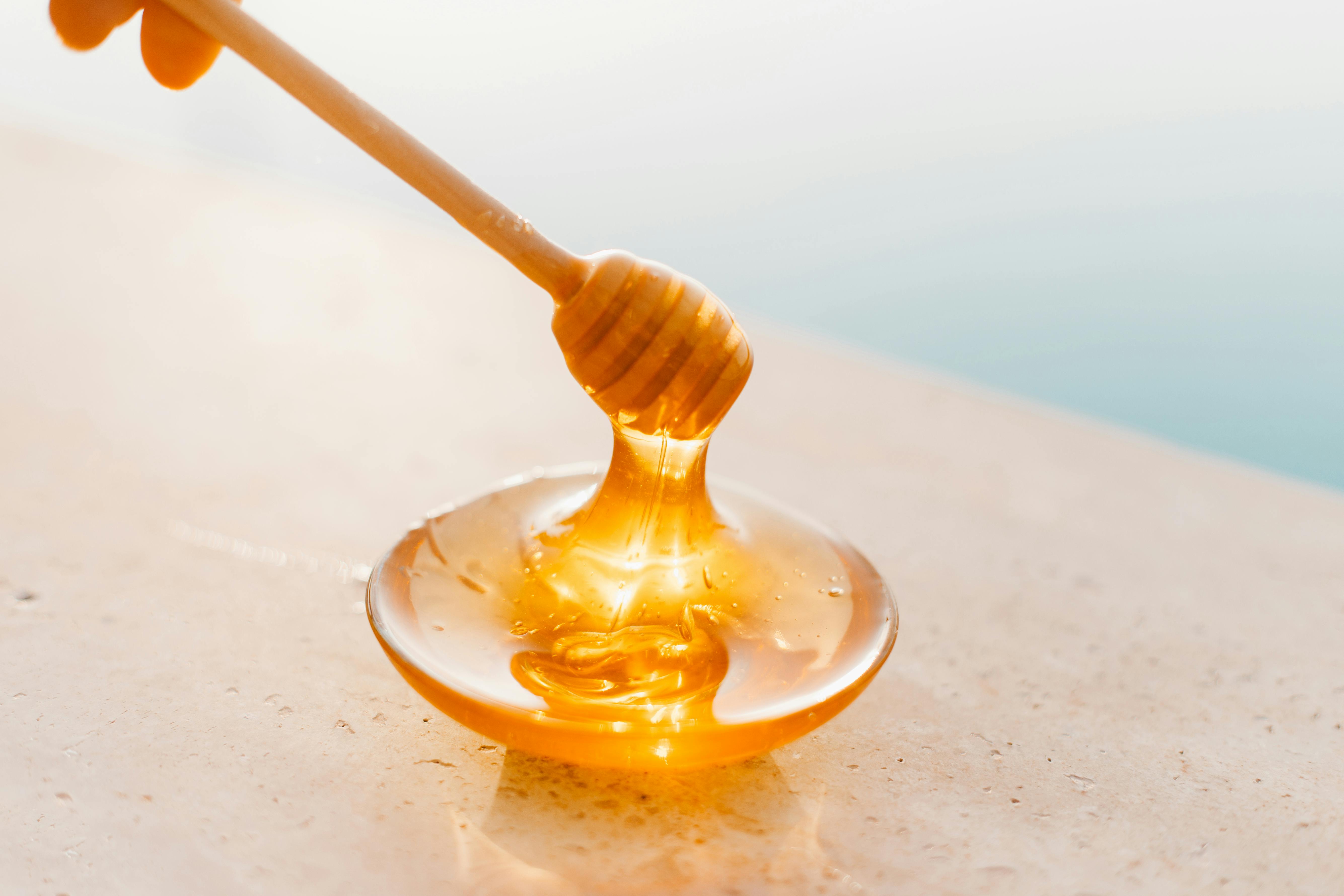
Diffusion is primarily controlled by viscosity. Viscosity is a measure of the fluid’s resistance to flow. Fluids with higher viscosity such as honey or maple syrup take more effort to get moving.
Vector Calculus Operators
In the Navier-Stokes equations above we see a lot of these upside down triangle symbols $\nabla$. That symbol is a Greek letter called lambda, and it is used to represent quite a few different vector calculus operations.
Here’s a table that describes their notation and what they mean:
| Vector Calculus Operator | Notation | Definition |
|---|---|---|
| Gradient Operator | $\nabla x$ | Shows the direction and rate of fastest increase of a scalar field |
| Divergence Operator | $\nabla \cdot \vec{x}$ | Shows how much a point acts like a source or sink |
| Curl Operator | $\nabla \times \vec{x}$ | Shows how much a field swirls or rotates around a point |
| Laplacian Operator | $\nabla^2 \; \vec{x}$ OR $\nabla^2 \; x$ | Shows how a value differs from the average around it |
Finite Difference Approximations
The definitions of these operators are used over continuous vector fields, however, our simulation data only exists at discrete intervals (which is wherever our pixels are located).
This means that we can’t directly use the definition of these operators in our equation but instead need to develop a discretized representation of them instead. This is done using finite difference models.
This table illustrates each operator and its equivalent finite difference approximation, which we will use when developing our shaders. Specifically, the approximations shown here are second-order centered finite difference approximations.
For simplicity, let $\vec{u}$ be a 2D vector field with components $u$ and $v$ such that $\vec{u} = (u,v)$, and let $p$ be a 2D scalar field. Then, each of these operators can be approximated as shown below:
| Operator | Continuous Definition | Finite Difference Approximation |
|---|---|---|
| $\nabla p$ | $\Large\left[ \frac{\partial p}{\partial x}, \frac{\partial p}{\partial y} \right]$ | $\Large\left[ \frac{p_{i+1,j} - p_{i-1,j}}{2\delta x}, \frac{p_{i,j+1} - p_{i,j-1}}{2\delta y} \right]$ |
| $\nabla \cdot \vec{u}$ | $\Large\frac{\partial u}{\partial x} + \frac{\partial v}{\partial y}$ | $\Large\frac{u_{i+1,j} - u_{i-1,j}}{2\delta x} + \frac{v_{i,j+1} - v_{i,j-1}}{2\delta y}$ |
| $\nabla \times \vec{u}$ | $\Large\frac{\partial v}{\partial x} - \frac{\partial u}{\partial y}$ | $\Large \begin{bmatrix} 0,0, \frac{v_{i+1,j} - v_{i-1,j}}{2\delta x} - \frac{u_{i,j+1} - u_{i,j-1}}{2\delta y} \end{bmatrix}$ |
| $\nabla^2 p$ | $\Large\frac{\partial^2 p}{\partial x^2} + \frac{\partial^2 p}{\partial y^2}$ | $\Large\frac{p_{i+1,j} - 2p_{i,j} + p_{i-1,j}}{(\delta x)^2} + \frac{p_{i,j+1} - 2p_{i,j} + p_{i,j-1}}{(\delta y)^2}$ |
| $\nabla^2 \vec{u}$ | $\Large\frac{\partial^2 u}{\partial x^2} + \frac{\partial^2 v}{\partial y^2}$ | $\Large\begin{bmatrix}\frac{u_{i+1,j} - 2u_{i,j} + u_{i-1,j}}{(\delta x)^2} + \frac{u_{i,j+1} - 2u_{i,j} + u_{i,j-1}}{(\delta y)^2} \atop \frac{v_{i+1,j} - 2v_{i,j} + v_{i-1,j}}{(\delta x)^2} + \frac{v_{i,j+1} - 2v_{i,j} + v_{i,j-1}}{(\delta y)^2}\end{bmatrix}$ |